

 |
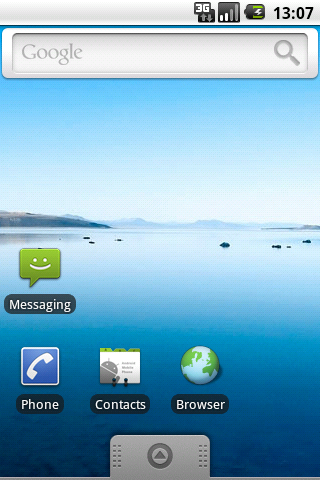
| The Android Emulator default home screen (v1.5) |
Android is a software stack for mobile devices that includes an operating system, middleware and key applications. Google Inc. purchased the initial developer of the software, Android Inc., in 2005.Android's mobile operating system is based on the Linux. The Android Open Source Project (AOSP) is tasked with the maintenance and further development of Android. Android was listed as the best-selling Smartphone platform world-wide in Q4 2010.
Android has a large community of developers writing applications ("apps") that extend the functionality of the devices. There are currently more than 250,000 apps available for Android.
Version history
Android has seen a number of updates since its original release. These updates to the base operating system typically fix bugs and add new features. Generally, each new version of the Android operating system is developed under a code name based on a dessert item. Past updates included Cupcake and Donut. The code names are in alphabetical order (Cupcake, Donut, Eclair, Froyo, Gingerbread, Honeycomb, and the upcoming Ice Cream Sandwich). Below is a list of the most recent versions, and what they include:
2.0 (Eclair) included a new web browser, with a new user interface and support for HTML5 and the W3C Geolocation API. It also included an enhanced camera app with features like digital zoom, flash, color effects, and more.
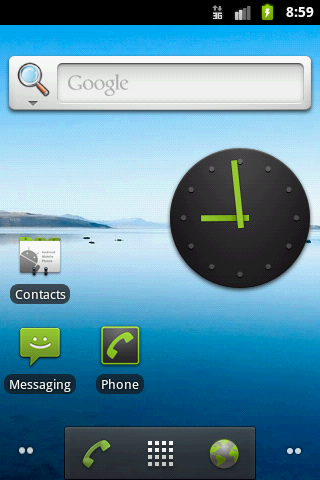
2.1 (Eclair) included support for voice controls throughout the entire OS. It also included a new launcher, with 5 homescreens instead of 3, animated backgrounds, and a button to open the menu (instead of a slider). It also included a new weather app, and improved functionality in the Email and Phonebook apps.
2.2 (Froyo) introduced speed improvements with JIT optimization and the Chrome V8 JavaScript engine, and added Wi-Fi hotspot tethering and Adobe Flash support
2.3 (Gingerbread) refined the user interface, improved the soft keyboard and copy/paste features, and added support for Near Field Communication
3.0 (Honeycomb) was a tablet-oriented release which supports larger screen devices and introduces many new user interface features, and supports multicore processors and hardware acceleration for graphics. The Honeycomb SDK has been released and the first device featuring this version, the Motorola Xoom tablet, went on sale in February 2011.
3.1 (Honeycomb) was announced at the 2011 Google I/O on 10 May 2011.
3.2 (Honeycomb) is "an incremental release that adds several new capabilities for users and developers." Highlights include optimization for a broader range of screen sizes; new "zoom-to-fill" screen compatibility mode; capability to load media files directly from the SD card; and an extended screen support API, providing developers with more precise control over the UI.
Below is a list of future releases that have been announced:
4.0 (Ice Cream Sandwich) is said to be a combination of Gingerbread and Honeycomb into a "cohesive whole." It will be released in Q4 2011.
| Handset layouts | The platform is adaptable to larger, VGA, 2D graphics library, 3D graphics library based on OpenGL ES 2.0 specifications, and traditional smartphone layouts. |
|---|---|
| Storage | SQLite, a lightweight relational database, is used for data storage purposes |
| Connectivity | Android supports connectivity technologies including GSM/EDGE, IDEN, CDMA, EV-DO, UMTS, Bluetooth, Wi-Fi (no connections through Proxy server[62] and no Ad hoc wireless network), LTE, NFC and WiMAX. |
| Messaging | SMS and MMS are available forms of messaging, including threaded text messaging and now Android Cloud To Device Messaging Framework(C2DM) is also a part of Android Push Messaging service. |
| Multiple language support | Android supports multiple human languages. The number of languages more than doubled for the platform 2.3 Gingerbread. Android lacks font rendering of several languages even after official announcements of added support (e.g. Hindi). |
| Web browser | The web browser available in Android is based on the open-source WebKit layout engine, coupled with Chrome's V8 JavaScript engine. The browser scores a 93/100 on the Acid3 Test. |
| Java support | While most Android applications are written in Java, there is no Java Virtual Machine in the platform and Java byte code is not executed. Java classes are compiled into Dalvik executables and run on Dalvik, a specialized virtual machine designed specifically for Android and optimized for battery-powered mobile devices with limited memory and CPU. J2ME support can be provided via third-party applications. |
| Media support | Android supports the following audio/video/still media formats: WebM, H.263, H.264 (in 3GP or MP4 container), MPEG-4 SP, AMR, AMR-WB (in 3GP container), AAC, HE-AAC (in MP4 or 3GP container), MP3, MIDI, Ogg Vorbis, FLAC, WAV, JPEG, PNG, GIF (though earlier versions do not support animated GIFs), BMP. |
| Streaming media support | RTP/RTSP streaming (3GPP PSS, ISMA), HTML progressive download (HTML5 <video> tag). Adobe Flash Streaming (RTMP) and HTTP Dynamic Streaming are supported by the Flash plugin. Apple HTTP Live Streaming is supported by RealPlayer for Mobile, and by the operating system in Android 3.0 (Honeycomb). Microsoft Smooth Streaming is planned to be supported through the awaited port of Silverlight plugin to Android. |
| Additional hardware support | Android can use video/still cameras, touchscreens, GPS, accelerometers, gyroscopes, magnetometers, dedicated gaming controls, proximity and pressure sensors, thermometers, accelerated 2D bit blits (with hardware orientation, scaling, pixel format conversion) and accelerated 3D graphics. |
| Multi-touch | Android has native support for multi-touch which was initially made available in handsets such as the HTC Hero. The feature was originally disabled at the kernel level (possibly to avoid infringing Apple's patents on touch-screen technology at the time). Google has since released an update for the Nexus One and the Motorola Droid which enables multi-touch natively.[68] |
| Bluetooth | Supports A2DP, AVRCP, sending files (OPP), accessing the phone book (PBAP), voice dialing and sending contacts between phones. Keyboard, mouse and joystick (HID) support is available through manufacturer customizations and third-party applications. Full HID support is planned for Android 3.0 (Honeycomb). |
| Video calling | Android does not support native video calling, but some handsets have a customized version of the operating system that supports it, either via the UMTS network (like the Samsung Galaxy S) or over IP. Video calling through Google Talk is available in Android 2.3.4 and later. |
| Multitasking | Multitasking of applications is available. |
| Voice based features | Google search through voice has been available since initial release. Voice actions for calling, texting, navigation, etc. are supported on Android 2.2 onwards. |
| Tethering | Android supports tethering, which allows a phone to be used as a wireless/wired hotspot. Before Android 2.2 this was supported by third-party applications or manufacturer customizations. |
| Screen capture | Android does not support screenshot capture as of 2011. This is supported by manufacturer and third-party customizations. |
